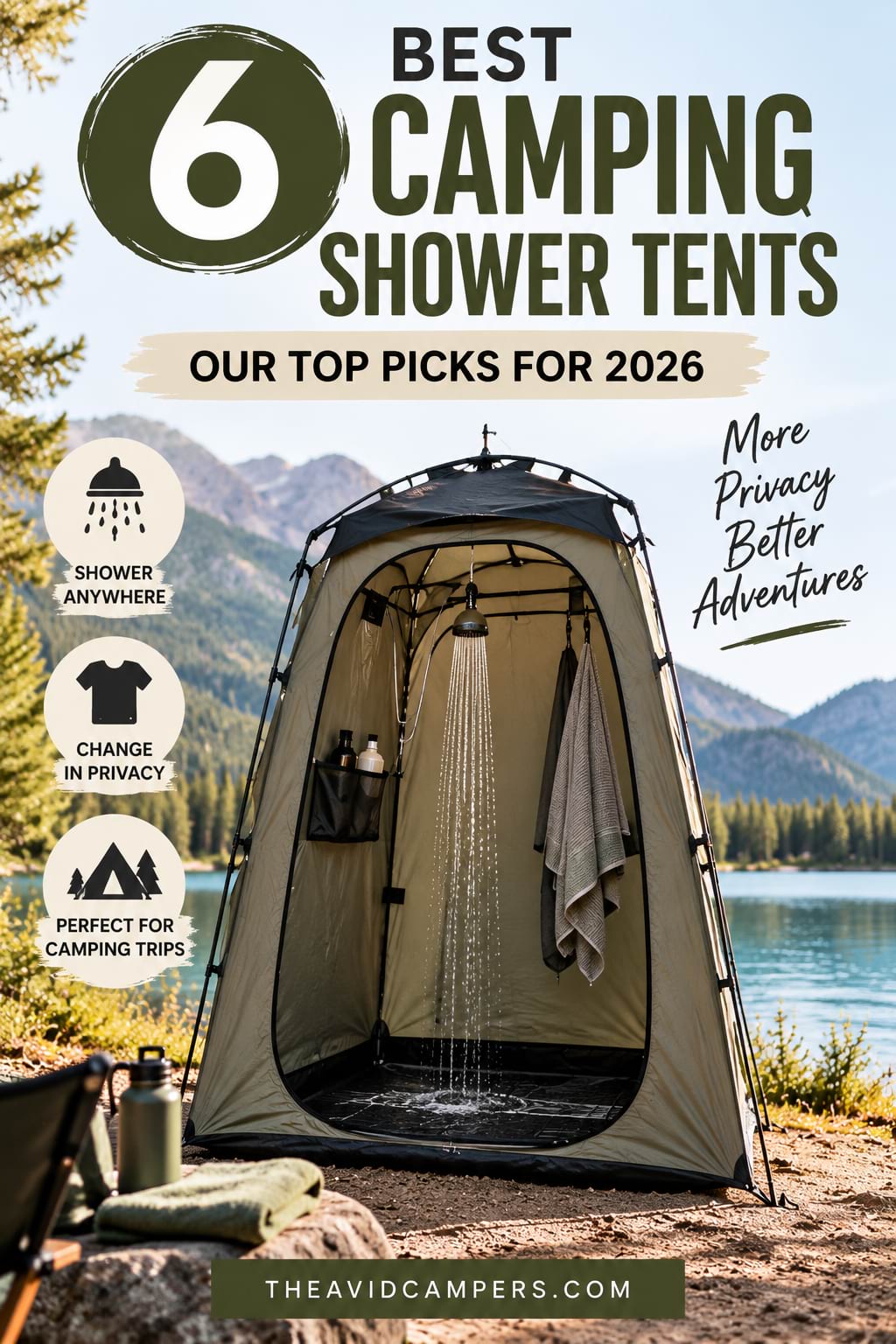

6 Best Camping Shower Tents: Our Top Picks for 2026
A good camping shower tent can make a huge difference when your campsite doesn’t have showers or you simply want a private place to change. But choosing one isn’t just about finding a tent tall enough to stand in – size, drainage, setup and stability can make the difference between something genuinely useful and something you regret packing.
Some are lightweight pop-up tents that are easy to pack and set up in seconds, while others give you more headroom, better drainage or even separate shower and changing areas. In this guide, we’ve narrowed it down to six of the best camping shower tents for different needs and budgets, whether you’re staying at a basic campground or dry camping without facilities.
This post contains affiliate links. As an Amazon Associate, I earn from qualifying purchases. If you buy through these links, I may earn a small commission at no extra cost to you. This helps support The Avid Campers and allows me to keep creating free outdoor content.
Quick Picks
- WolfWise PRO Pop-Up Shower Tent (Best Overall): the best balance of instant setup, headroom and shower-specific features for one person.
- WolfWise Blazers A20 (Best Budget Pop-Up): straightforward, inexpensive privacy that goes up in seconds, if you don’t need the extra height.
- KingCamp Double Room (Best Two-Room Shower Tent): for families and anyone who wants clothes and towels kept in a separate dry room.
- Vidalido Outdoor Shower Tent (Best Spacious Single Room): the pick for taller campers who hate feeling boxed in.
- Wakeman Pop Up Changing Tent (Best Lightweight Privacy Tent): packable privacy for changing, the beach or a camp toilet, rather than a shower-first design.
- CORE Two Room Instant Shower Tent (Best Camp Bathroom): two rooms and a pre-attached instant frame, at the cost of real bulk.
Camping Shower Tents Compared
| Product | Best For | Open Size | Weight | Setup | Rooms | Floor |
|---|---|---|---|---|---|---|
| WolfWise PRO Pop-Up Shower Tent | Best overall | 47.2 x 47.2 x 78.7 in | — | Instant pop-up | 1 | Attached mat, mesh drainage corners |
| WolfWise Blazers A20 | Best budget pop-up | 47.2 x 47.2 x 74.8 in | 4.19 lb | Instant pop-up | 1 | Removable mat |
| KingCamp Double Room | Families, wet and dry split | 82.7 x 41.7 x 83.9 in | 19.56 lb | Fiberglass and steel poles | 2 | PE floor |
| Vidalido Outdoor Shower Tent | Space and height | 55 x 55 x 86.5 in | 13 lb | Pole assembly | 1 | — |
| Wakeman Pop Up Changing Tent | Packable privacy | 39.6 x 39.6 x 74.4 in | 5.24 lb | Instant pop-up | 1 | Removable bottom |
| CORE Two Room Instant | Full camp bathroom | 7 x 3.5 ft, 84 in center height | 21 lb | Instant pre-attached frame | 2 | Padded floor, shower side |
The 6 Best Camping Shower Tents
1. WolfWise PRO Pop-Up Shower Tent
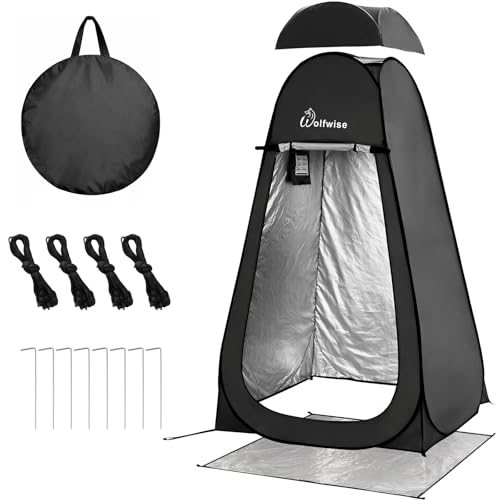
Our top pick for most campers. Quick pop-up setup, a roomy 79-inch height and a drain-friendly floor make it a practical choice for showering, changing and campsite privacy.
Best For: campers who want to genuinely shower inside a pop-up shelter rather than just change clothes in one.
Most inexpensive privacy pods top out somewhere around 6 ft 2, which is fine for pulling on shorts and miserable for washing your hair. The WolfWise PRO stands 78.74 inches, close to 6 ft 7, on a 47.24 inch square footprint. That extra height is the whole point. It means the shower nozzle sits above your head instead of level with it, and it means taller campers are not ducking through the rinse.
The shower-specific details matter more than the height on its own. The floor is an attached bottom mat with mesh corners, so water that hits the floor has somewhere to go instead of pooling around your feet. The top has a zippered opening that can take a shower hose or nozzle, which is what separates a shower tent from a changing tent. There is side and window ventilation to move the steam, plus interior storage for soap and a phone. The fabric is a 190T nylon and polyester taffeta, and the whole thing pops open with no assembly.
Like most lightweight pop-up tents, the WolfWise PRO needs to be properly secured outdoors. Use the stakes and guy lines in breezy conditions, as the flexible frame can move around in the wind. Treat the roof opening as a pass-through for a hose, not as a mounting point for a full water bag. If you want a bag hanging overhead, check what the manufacturer says the frame will carry and support the bag externally if there is any doubt.
Against the Blazers A20 below, the PRO buys you about four extra inches of headroom, a drainage-friendly floor and a top opening built for a shower hose. If showering is the actual plan, that is the version to get.
Pros
- Close to 6 ft 7 of interior height, well above most pop-up privacy pods
- Attached floor mat with mesh corners so shower water can drain away
- Top zippered opening designed to take a shower hose or nozzle
- Instant pop-up setup with interior storage for toiletries
Cons
- Lightweight spring frame that has to be staked and guyed outdoors
- One person, one room, so wet gear and dry clothes share the same space
- Spring-frame tents take practice to fold back into the bag
2. WolfWise Blazers A20 Pop-Up Privacy Tent
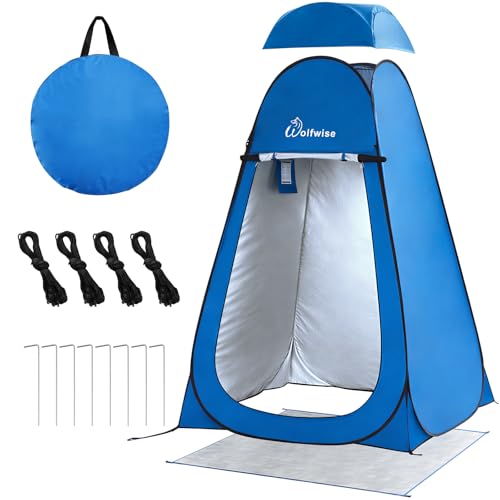
A simple, affordable pop-up option for campers who want quick privacy without a complicated setup. At just 4.19 lb, it’s easy to pack for changing, campsite privacy or occasional shower use.
Best For: cheap, instant privacy at the campsite or the beach when a shower is a bonus rather than the point.
The Blazers A20 is the same idea as the WolfWise PRO with the specification dialed back. It opens to 47.2 inches square and 74.8 inches tall, so about 6 ft 2 of headroom, and it folds down to roughly a 22.8 inch disc that slides behind a car seat. At 4.19 lb it is light enough to pick up assembled and move to a better spot, and setup is instant, with no poles and no assembly.
For the price you pay you still get the useful benefits. The bottom mat is removable, so you can leave it in for changing and take it out when you want water running straight onto the ground. There is a removable rain cover on the roof and two zippered windows plus the entrance for ventilation, which matters more than it sounds inside a sealed 190T polyester box on a warm afternoon.
The compromise is height. Four inches sounds trivial until you are rinsing shampoo out with a nozzle brushing your scalp. Anyone over about six feet who plans to shower rather than change should read the WolfWise PRO entry above instead. Being that light cuts both ways too, so the stakes and guy lines are not optional once it is set up outside.
Pros
- Opens and closes in seconds with no poles or assembly
- 4.19 lb and packs down to a flat disc of roughly 22.8 inches
- Removable floor mat and removable rain cover for flexible use
- Two zippered windows plus a large entrance for airflow
Cons
- 74.8 inches of height is tight for showering if you are tall
- Light spring frame that needs proper anchoring outdoors
- Not a shower-first design, so plan how the water gets overhead
3. KingCamp Double Room Camping Shower Tent

A roomy two-compartment setup that keeps the shower area separate from a dry space for clothes and towels. A practical choice for families and longer car-camping stays.
Best For: families and couples who want a genuinely dry place to leave clothes and towels while somebody showers.
The single most annoying thing about a one-room shower tent is that everything inside gets damp. Your towel, the clean clothes you hung on the strap, the toiletry bag. The KingCamp solves it with an 82.7 by 41.7 inch footprint split into two rooms with two doors, so one side stays a wet shower stall and the other stays a dry changing room. At 83.9 inches tall, both sides have real standing height.
This is not a pop-up, and it is worth being clear about that because it is often listed as one. It goes up with a conventional frame of fiberglass and steel poles and clips, which takes a few minutes rather than a few seconds. What you get for that time is a freestanding shelter in 150D Oxford fabric with a PU coating, a PE floor, top and side screens for ventilation, internal storage, hanging provisions for clothes and towels, and hooks intended for a shower bag. Some versions ship with a 20 liter solar shower bag, which is roughly 5.28 gallons.
It packs to about 22.8 by 7.8 by 7.8 inches and weighs 19.56 lb, so this is a car-camping item. It is also tall with a large side profile, which makes it a sail in an exposed site. Stake it and use the guy lines every time. If you like the two-room layout but want to skip the pole assembly, compare it against the CORE below, which does the same job with a pre-attached instant frame and more bulk.
Pros
- Two rooms with two doors, so wet and dry areas stay separate
- 83.9 inches of standing height across both sides
- 150D Oxford fabric with PU coating over a fiberglass and steel frame
- Internal storage, hanging provisions and shower-bag hooks
- Packs to a compact 22.8 inch bag despite the footprint
Cons
- Conventional pole and clip assembly, not an instant setup
- 19.56 lb, so it is a car camping and RV item
- Large side profile that needs staking and guying in wind
4. Vidalido Outdoor Shower Tent

A roomy single-person option with a 55-inch-square footprint and over 7 ft of height. A great choice for taller campers or anyone who wants more space to move around while showering.
Best For: taller campers and anyone who wants elbow room in a single-room shelter.
Height gets all the attention in shower tent listings, but floor area is what stops your forearms hitting wet fabric. The Vidalido is 55 inches square, which works out to roughly 21 square feet of floor, against about 15.5 square feet for a 47 inch pop-up pod and about 10.9 square feet for the Wakeman further down. That is the difference between washing your hair with your elbows tucked in and washing your hair normally. Add 86.5 inches of height, over seven feet, and there is genuine room to bend down and reach your feet without folding into the wall.
Structurally it sits between the pop-ups and the two-room shelters. It is pole-supported rather than a spring-wire pod, so it holds its shape better than something that snaps open, and it comes with the full kit: poles, stakes, ropes, a rainfly and a carry bag. Ventilation comes from a mesh window.
The trade is portability. At about 13 lb and a packed size of roughly 25 by 7 inches, it is heavier and longer than any pop-up here, and setup involves actual assembly. It is also a single room, so towels and clean clothes still share space with the shower unless you hang them outside. If you want the space without the assembly, nothing here matches it, which is exactly why it earns a place beside the smaller pods.
Pros
- Roughly 21 square feet of floor, far more usable than a 47 inch pod
- 86.5 inches of height suits tall campers comfortably
- Pole-supported structure holds its shape better than a spring frame
- Ships with poles, stakes, ropes, rainfly and carry bag
Cons
- About 13 lb, so it is noticeably heavier than a pop-up pod
- Setup takes assembly rather than seconds
- One room, so wet and dry gear share the same space
5. Wakeman Pop Up Changing Tent

A compact pop-up privacy tent for changing, beach trips or screening a portable toilet. The removable floor, sandbag pockets and instant setup make it a versatile option when space and easy packing matter.
Best For: packable campsite privacy for changing, the beach or screening a portable toilet.
The Wakeman opens to 3.3 by 3.3 by 6.2 ft, which is 39.6 inches square and 74.4 inches tall, and weighs 5.24 lb. The footprint is the smallest here at roughly 10.9 square feet, so it takes up less room at a busy site and less room in the car, and it still gives about 6 ft 2 of standing height for changing. It pops up instantly with no pole assembly and goes back into a zippered carry bag.
What it does better than most cheap privacy pods is stay put and stay flexible. It ships with four stakes and guy lines, and it has two sewn-in pockets you can weight with sandbags, which is a genuine advantage for a light shelter on a windy beach or an exposed pitch. The bottom is removable, so you can leave it in for changing and take it out when water is running, and the dual-sided zippered door means you are not fixed to one approach when you site it.
Be clear about what it is. This is a privacy and changing shelter that can handle the occasional rinse, not a shower-first design. At 74.4 inches it is no taller than the Blazers A20, so taller campers who want to shower properly should be looking at the WolfWise PRO instead. The frame is light pop-up construction, so don’t hang a heavy water bag from it unless the manufacturer says the structure will take it. On weight alone the Blazers A20 is actually the lighter of the two; what the Wakeman adds is the smaller footprint, the dual-sided door and the sandbag pockets.
Pros
- 5.24 lb and the smallest footprint here at about 10.9 square feet
- Instant pop-up with no poles, packs into a zippered carry bag
- Four stakes, guy lines and two sewn-in pockets for sandbag weighting
- Removable bottom, so it works for changing or for running water
- Dual-sided zippered door gives you options on where to site it
Cons
- 74.4 inches of height is restrictive if you want to shower comfortably
- A privacy and changing shelter first, with showering as a secondary use
- Light pop-up frame, so anchoring is part of the setup rather than optional
6. CORE Two Room Instant Shower Tent
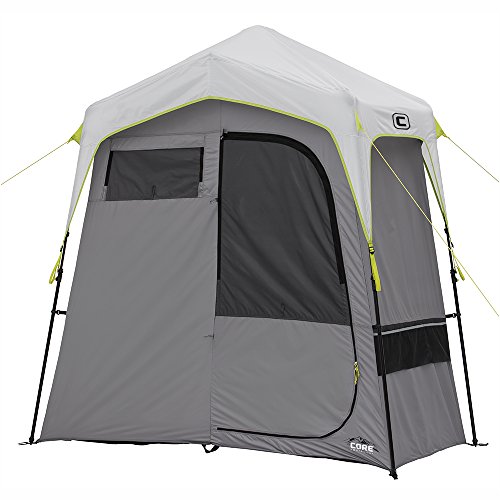
A substantial two-room setup with separate shower and changing areas and a pre-attached instant frame. Best for car campers who want more comfort and faster setup and don’t mind the extra bulk.
Best For: car campers who want a proper camp bathroom without assembling a pole frame.
This is the most substantial shelter in the guide. The footprint is 7 by 3.5 ft with an 84 inch center height, split into a shower room and a changing room by a zippered divider, and the poles come pre-attached to the tent body. CORE states setup in as little as 60 seconds, which is the real advantage here: you unfold it and extend the legs rather than threading anything. It also has more weather protection than the lightweight pop-ups, with 1200 mm water-repellent fabric, sealed construction and a rainfly.
The interior is built around actually using it. The shower side has a padded floor so you are not standing barefoot on grit, the ceiling is mesh with closable windows for airflow, and there are storage pockets and towel bars in both rooms. The current version includes a 5-gallon shower bag.
Set it against the KingCamp and the choice is clear enough. Both give you the wet and dry split, and neither is remotely portable. The CORE trades weight and pack size for a frame that goes up in a minute; the KingCamp trades setup time for a lighter, much shorter packed bundle. At 21 lb, with a seven foot frame and a long packed bundle, this is the bulkiest thing here, so it lives beside a car, an RV or a backyard pool. Carrying it any distance is not the plan.
Pros
- Pre-attached instant frame, with a stated setup of as little as 60 seconds
- Two rooms separated by a zippered divider
- 1200 mm water-repellent fabric with sealed seams and a rainfly
- Padded floor on the shower side and a mesh ceiling for ventilation
- Includes a 5-gallon shower bag, plus towel bars and storage pockets
Cons
- 21 lb, far heavier and bulkier than any pop-up here, strictly a car camping item
- The packed bundle is long and awkward, so it eats trunk space
- Large surface area, so staking and guying matter in wind
How to Choose a Camping Shower Tent
Size and headroom
Height is the number every listing leads with, and it only tells half the story. A 47 inch square pod gives you about 15.5 square feet of floor, a 55 inch square shelter gives about 21, and a 39.6 inch pod gives about 10.9. Showering takes more room than standing still: you need to raise both arms to wash your hair, turn around to rinse, and bend down to reach your feet without pressing your back into a wet wall. Work out your height plus a few inches of clearance for a nozzle, then look hard at the floor dimensions, because that is where the cramped feeling actually comes from.
One room or two
A single-room shelter puts your towel, your clean clothes and your shower in the same 15 square feet. It works, and people manage it every weekend by hanging things outside or in the car, but it is the thing most owners complain about. A two-room shelter with a zippered divider keeps a genuinely dry side for changing, which matters most for families, for cool weather, and for trips where you are showering every day rather than once.
The cost is size. Two-room shelters here run to seven feet long, weigh around 20 lb, and take longer to put up. That is fine next to a car or an RV and unworkable if you are carrying gear any real distance.
Pop-up or pole frame
Spring-frame pop-ups open in seconds with no assembly and pack into a flat disc. The trade is rigidity. A spring frame flexes, so it needs stakes and guy lines to hold its shape in any breeze, and folding it back down has a real learning curve the first few times.
Conventional pole shelters, like the KingCamp, take a few minutes to build with clips and poles, and hold their shape better once they are up. Instant frames, like the CORE, sit in between: the poles are pre-attached, so you unfold the shelter and extend the legs, which is quick but produces a long, bulky packed bundle. Match the setup style to how often you will actually move it.
Floor and drainage
Shower water has to go somewhere. Different designs handle it differently and none of them is right for every site. A removable mat lets you take the floor out entirely so water drains straight into the ground, which suits gravel and grass. Mesh drainage corners on an attached floor keep the mat in place while letting water escape at the edges. A two-room layout confines the water to one side and keeps the other dry. Sealed floors keep dirt out but hold water in, so they suit changing more than showering.
Whichever design you pick, think about where that water ends up. On packed dirt it puddles, and a pallet, a rubber mat or a patch of gravel underneath makes a real difference.
💡 Insider Tip: Know where your shower water is allowed to go
Shower water counts as gray water, and where it can go is not up to you. Federal land managers, including the Forest Service, follow the Leave No Trace guidance of keeping washing and wastewater at least 200 feet from streams and lakes, using small amounts of biodegradable soap and scattering the strained water widely rather than dumping it in one spot. Many developed campgrounds have a designated gray water disposal point, and some areas prohibit dumping wastewater on the ground entirely, so check the local rule before you pick your spot.
Ventilation
A closed fabric box with hot water in it turns into a steam room fast, and a steamed-up tent is unpleasant to stand in and slow to dry out afterwards. Mesh windows, a mesh or vented roof and a large door all help move air through while you are inside. In cooler weather the same vents that stop the condensation make it cold to stand there wet, so it is worth having a plan for warming up straight afterwards, which is a large part of how to stay warm in a tent.
Shower bag support
This is the detail that catches people out. A tent being compatible with a shower hose does not mean its roof or frame can carry a full water bag. Five US gallons of water weighs about 42 lb on its own, before the weight of the bag, and that load hangs from a single point at the top of the shelter.
💡 Insider Tip: Check the load figure before you hang a full bag
Check the manufacturer’s stated load figure rather than assuming the hooks can take a full bag. KingCamp, for example, publishes a maximum load-bearing capacity of 15 kg (33 lb) for its double room shower tent, which is less than the roughly 42 lb of water in a filled 5-gallon bag. Filling the bag partway, or hanging it from a tree branch, a truck rack or a separate stand and running the hose in through the roof opening, keeps you inside the rating and puts the load somewhere it belongs.
Stability and wind
A shower tent is a tall, flat-sided box with nothing heavy inside it, which is close to the definition of a sail. Stakes, guy lines and any weight or sand pockets the manufacturer supplies are part of the setup, not optional extras, and every shelter here needs them outdoors. Site it with some thought as well. Behind a vehicle, a hedge or a stand of trees beats out in the open, and pointing the door away from the prevailing wind keeps it from filling like a parachute when you open it.
Packed size and weight
There is a wide spread here: 4.19 lb for the Blazers A20, 5.24 lb for the Wakeman, 13 lb for the Vidalido, 19.56 lb for the KingCamp and 21 lb for the CORE. Next to a car, an RV or a campground parking spot, none of those numbers matters much. Carrying gear any real distance changes the calculation completely, and none of the two-room shelters belongs on your back. Check packed length too, not just weight, because the instant-frame shelters pack long and awkward even when the weight sounds reasonable.
Privacy
Look at how completely the shelter closes: a full-length door zipper, window covers you can shut from the inside, and an opaque or coated fabric rather than a thin single layer that lights up like a lantern at dusk. Removable floors leave a gap at ground level, which is worth thinking about at a busy campground. No fabric makes a lit tent completely opaque at night, so if privacy after dark matters, set up away from the main path and keep lanterns outside the tent rather than in it.
Camping Shower Tent FAQs
What is a camping shower tent?
A camping shower tent is a small, freestanding fabric shelter that gives you a private enclosure at a campsite. Most are used for three jobs: showering with a portable or solar shower bag, changing clothes, and screening a portable camping toilet. Designs range from lightweight pop-up privacy pods to two-room shelters with a separate wet and dry side.
Do camping shower tents have floors?
It varies, and the design tells you what the tent is really for. Some have an attached floor mat with mesh corners or edges so shower water can drain away. Some have a fully removable mat you can take out to let water run straight into the ground. Some two-room models have a floor on the shower side only. Others are floorless by design to keep the fabric clean. Check the floor description before buying, because it decides how well the tent handles running water.
Can you hang a 5-gallon shower bag from a shower tent?
Only if the manufacturer says the structure can carry it. Five US gallons of water weighs roughly 42 lb before you count the bag itself, and that load hangs from one point at the top of the shelter. Some pole-built tents publish a maximum load figure, and it can be well below the weight of a full bag. Lightweight spring-frame pop-ups are generally not designed to carry a filled bag at all, even when they have a roof opening for a hose. When in doubt, fill the bag partway or hang it from a branch, a vehicle rack or a separate stand and feed the hose in through the roof opening.
Can a shower tent be used with a portable camping toilet?
Yes, many privacy shelters work well for this, and it is one of the most common reasons people buy one. Check that the floor arrangement suits it, since some models have a floor opening or a removable mat intended for exactly this, and check the footprint against your toilet so there is still room to stand and turn. Not every shower tent is designed around toilet use, so read the product description rather than assuming.
How do you keep a shower tent from blowing over?
Use everything it comes with. Stake every corner, run the guy lines out to full tension, and fill any sand or weight pockets the manufacturer supplies. Position matters just as much: set it behind a vehicle, a hedge or trees where you can, keep the door out of the prevailing wind, and take the tent down rather than leaving it standing unattended if the wind picks up. Tall, empty, flat-sided shelters catch wind easily, and pop-ups are the most vulnerable of the lot.
Are pop-up shower tents difficult to fold?
Setup is the easy part, since a spring-frame tent opens itself in seconds. Folding it back down is the bit with a learning curve, because the frame has to be twisted into overlapping loops in a specific sequence. It is much easier once you have done it a few times. Follow the manufacturer’s folding instructions or video rather than forcing the frame, since bending it out of shape is what ruins these tents.
Do you actually need a shower tent for camping?
Not everyone does. If you mostly camp at developed campgrounds with a bathhouse, a shower tent is dead weight. It earns its place when there are no facilities, which covers dispersed and dry camping, primitive sites, longer trips where a rinse becomes a daily thing, families cycling several people through in a row, and anyone running a portable toilet. It is also genuinely useful outside camping, at the beach, at trailheads and after paddling or surfing.
Which One Should You Buy?
For most people the WolfWise PRO is the right call: quick to put up, tall enough to shower in and built with drainage and a hose opening rather than just four walls. Go for the KingCamp Double Room if keeping clothes and towels dry in a separate room matters more than setup time, and the CORE if you want that same two-room layout with a frame that goes up in a minute and don’t mind the bulk. If you are mainly after privacy for changing or a camp toilet and want it to take up as little space as possible, the Wakeman Pop Up Changing Tent does that at 5.24 lb.