9 Most Stunning US National Parks for Fall Colors (2026)!
National parks are the most reliable places in the country to catch peak fall color, and it is not really about scenery. It is about elevation. A park that spans several thousand feet of altitude spreads its color over weeks rather than days, so a badly timed trip can often be rescued by driving uphill or down.
Protected forest helps too. You get mature hardwood stands and long uninterrupted sightlines instead of the patchwork you see from most highways.
These are the nine national parks worth building an autumn trip around, ordered by how good the display actually is rather than by how famous the park is. Each entry has its peak color window, what you need to reserve, and a trail or two worth the drive.
This post contains affiliate links. As an Amazon Associate, I earn from qualifying purchases. If you book or buy through these links, I may earn a small commission at no extra cost to you. This helps support Avid Campers and allows me to keep creating free outdoor content.
How to Use This List
The order is deliberate. Number one has the longest and most dependable color season in the country. Number nine is the one you can do on a Saturday afternoon with kids and no planning at all. Everything in between is ranked on the quality of the display first and the hassle of getting to it second, and the reasoning is stated in each entry so you can disagree with it.
One thing to sort out before anything else: four of these nine now need something booked in advance, and two of those sell out. Read the reservation notes in each entry before you book flights or lodging, not after.
1. Great Smoky Mountains National Park, Tennessee and North Carolina
Peak color: mid-September to early November, by elevation | Entrance fee: none | Parking tag required: $5 daily, $15 weekly, $40 annual
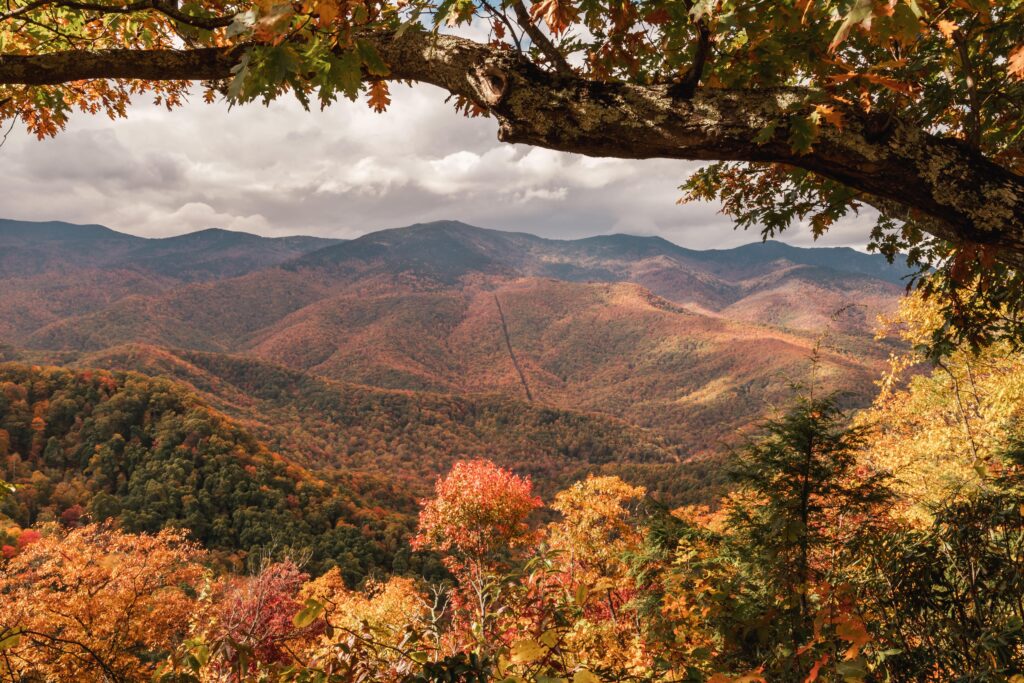
Nothing else in the eastern US comes close on duration. The park runs from roughly 875 feet to over 6,600 feet, holds more than 100 native tree species, and takes six to eight weeks to move color from the summits to the valley floors. Whatever week in October you can travel, some part of this park is peaking.
Above 4,000 feet, the display starts changing in mid-September and peaks in the first two weeks of October, led by yellow birch, American beech and mountain maple. Kuwohi, the 6,643-foot summit renamed from Clingmans Dome in 2024, plus Newfound Gap and Mount Le Conte, are the high-elevation anchors. The 2,500 to 4,000-foot band peaks mid to late October and is the best of the whole season, with sugar maple, scarlet oak and hickory adding the deep reds. Below 2,500 feet, Cades Cove, Deep Creek and the areas around the park entrances hold on into early November.
Newfound Gap Road climbs from about 1,400 feet in Gatlinburg to 5,046 feet at the state line, which means one drive in mid-October shows you three stages of autumn at once. Cades Cove is an 11-mile one-way loop through open pasture ringed by color, best in late October and best attempted before 9am or after 3pm unless you enjoy stationary traffic.
For walking, Andrews Bald is a 3.6-mile round trip from the Kuwohi parking area to a high grassy bald with open views, and Alum Cave Bluffs is about 4.4 miles round trip with Arch Rock making a natural shorter turnaround. Check current trail closures before you commit to either, since the park rotates rehabilitation work through its busiest trails.
Honest warning: this is the most-visited national park in the country and October is its busiest month, at roughly 1.6 million visits. The color is worth it. The Saturday traffic on Newfound Gap Road is not.
💡 Insider Tip: There is no entrance fee here, and there never has been. What you need is a parking tag, required for any vehicle parked more than 15 minutes: $5 daily, $15 weekly, $40 annual. Driving straight through without stopping costs nothing. Two things people get caught by: the tag has to show your license plate and cannot be moved between vehicles, and it buys you the right to park, not a guaranteed space. Popular lots still fill, so have a backup trailhead in mind.
2. Acadia National Park, Maine
Peak color: mid to late October | Entrance fee: $35 per vehicle, valid 7 days | Book ahead: Cadillac Summit Road vehicle reservation, $6, required 20 May to 25 October 2026
Acadia is the only park on this list where the color meets the Atlantic. Granite headlands, spruce, and hardwood ridges turning red and gold above the water is a combination you cannot get anywhere else in the system, and it is the reason Acadia photographs the way it does in October.
The Park Loop Road is the obvious circuit, and Jordan Pond gives you the reflection shot with the Bubbles behind it. For walking, the 45 miles of historic carriage roads are the most underrated asset in the park in autumn: crushed stone, gentle grades, stone bridges, and hardwood canopy the whole way. Beech Mountain and the Bubbles are short climbs with disproportionate views.
Cadillac Mountain is the one thing that needs organising. A vehicle reservation is required to drive the Summit Road from 20 May through 25 October 2026, costing $6 per vehicle on top of the park entrance pass. Vehicles over 21 feet, including bike racks and hitch attachments, plus RVs and trailers, are not allowed on the road at all, and the Island Explorer shuttle does not go up there.
The honest counterpoint: hiking or biking to the Cadillac summit is free and needs no reservation, and the rest of Acadia needs nothing booked whatsoever. Missing a summit slot is a minor inconvenience, not a ruined trip.
💡 Insider Tip: Cadillac reservations are released in two separate waves, which is the part most people miss. Roughly 30 percent open 90 days ahead, and the remaining 70 percent open just two days ahead at 10am Eastern. If you missed the 90-day window you still have a real shot two mornings before. Sunrise slots are the most competitive of all. Save the QR code to your phone or print it before you drive in, because cell signal in the park is unreliable and a ranger has to scan it at the gate.
3. Grand Teton National Park, Wyoming
Peak color: late September to early October | Entrance fee: $35 per vehicle, valid 7 days | Book ahead: nothing required for entry
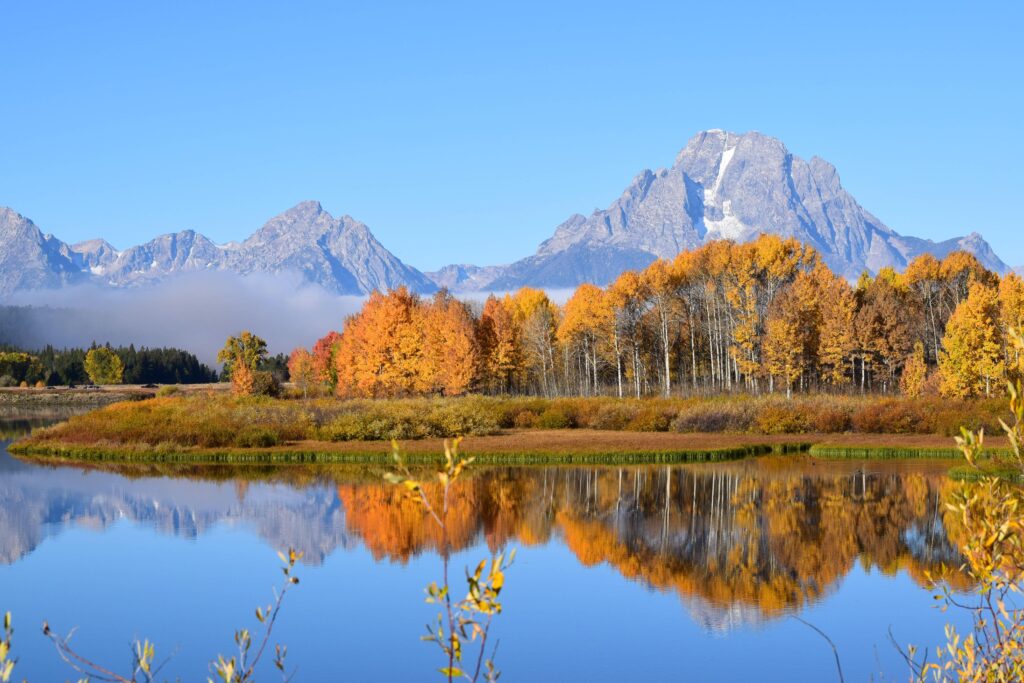
Grand Teton gives you the most dramatic backdrop of any park on this list. Cottonwoods and aspens turning gold along the Snake River with the Teton range rising straight out of the valley behind them needs no explanation and very little hiking.
Aspens start turning at higher elevations around Signal Mountain and work downslope, with cottonwoods along the river following several days later. Late September into the first few days of October is the window. Oxbow Bend is the classic, a crescent of the Snake River with Mount Moran behind it. Schwabacher Landing gives you the same range reflected in slower water with fewer people. Willow Flats and the Moose-Wilson Road are the wildlife stops.
The bonus here is timing. The elk rut runs through late September and into October, which means the same trip that gets you peak aspen also gets you bull elk bugling across the valley at dawn and dusk. Moose are active in the willows around Oxbow Bend and the Gros Ventre area at the same time.
Be clear-eyed about what kind of park this is in autumn: most of the best color is roadside. It is a drive-and-pullout experience more than a hiking one, which makes it a genuinely good option if you are travelling with people who do not want a 2,000-foot climb. This is serious bear country, so carry bear spray, stay 100 yards from bears and wolves and 25 yards from everything else, and be aware that wildlife behaviour gets more defensive as winter approaches.
💡 Insider Tip: Both Oxbow Bend and Schwabacher Landing face west toward the Teton range, which makes them morning locations rather than sunset ones. At first light the water is at its flattest and the peaks are lit from the front. By late afternoon you are shooting into the sun and the reflection has usually been broken up by wind. If you only have one clear morning in the park, spend it at one of these two.
4. Shenandoah National Park, Virginia
Peak color: third week of October at mid and lower elevations | Entrance fee: per vehicle, valid 7 days | Book ahead: nothing required
Shenandoah is the most accessible large-scale autumn display in the East. Skyline Drive runs 105 miles along the ridge from Front Royal to Rockfish Gap with 75 overlooks, and at peak the road becomes a tunnel of color with long views over the Shenandoah Valley on one side and the Piedmont on the other.
Color develops above 3,500 feet in early October and reaches peak at mid and lower elevations in the third week of the month. The park is busiest during the final three weeks of October, and a Saturday on Skyline Drive can be bumper to bumper for hours. A weekday visit is a genuinely different experience.
Stony Man is the pick for effort-to-payoff: a 1.6-mile round trip from the parking area at the northern entrance to Skyland, ending on the highest ground in the park with a panorama that takes in Massanutten Mountain and the town of Luray. Blackrock Summit is an easy 1-mile loop to a boulder field with equally big views. At the southern end, Skyline Drive meets the northern terminus of the Blue Ridge Parkway, so you can keep going for another 469 miles if color is holding further south.
Where you enter matters more than most visitors realise. The Central District, between the Thornton Gap and Rockfish Gap entrance stations, holds the park’s highest ground, so an early-October visit should start there rather than at the northern end.
5. Rocky Mountain National Park, Colorado
Peak color: mid to late September | Entrance fee: per vehicle | Book ahead: timed entry reservation required, $2 processing fee
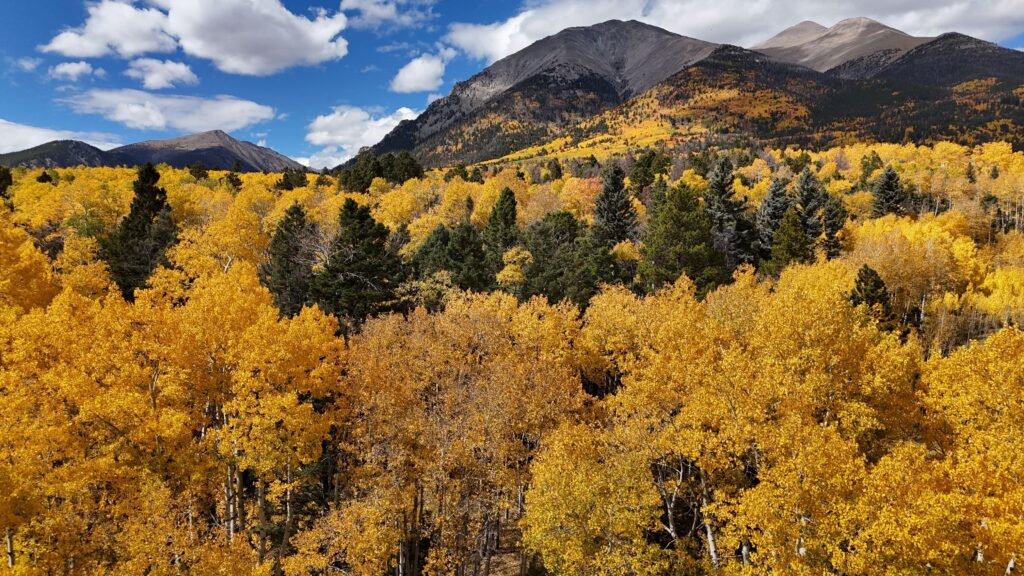
Rocky Mountain is aspen country, which means gold rather than the eastern mosaic of reds and oranges. What you get in exchange is scale and altitude: whole hillsides of clonal aspen turning at once, framed by peaks that already have snow on them by late September.
The color runs on elevation like everywhere in Colorado. The high country goes first in mid-September, and the montane valleys follow through late September into early October. As in Grand Teton, the elk rut overlaps with peak color, and the meadows around Moraine Park and Horseshoe Park are among the most reliable places in the country to hear bugling at dawn.
The friction here is the reservation system, and it is worth understanding properly rather than guessing. In 2026 there are two separate permits. The standard timed entry covers everything except the Bear Lake Road corridor and applies from 22 May to 12 October, but only between 9am and 2pm. The Timed Entry Plus Bear Lake Road permit covers the whole park including that corridor and applies from 22 May to 18 October, from 5am to 6pm. Both are booked on Recreation.gov for a $2 processing fee, and a park entrance pass is still required on top.
Reservations are released in monthly batches, with a further tranche going live at 7pm Mountain time the night before each arrival date. Those last-minute ones do go quickly.
💡 Insider Tip: The standard timed entry permit only bites between 9am and 2pm. If you are through the entrance station before 9am you do not need one at all, which for a foliage trip is not much of a sacrifice: dawn is when the elk are bugling and the aspens are best lit anyway. This does not apply to the Bear Lake Road corridor, which runs 5am to 6pm and genuinely needs the permit.
6. North Cascades National Park, Washington
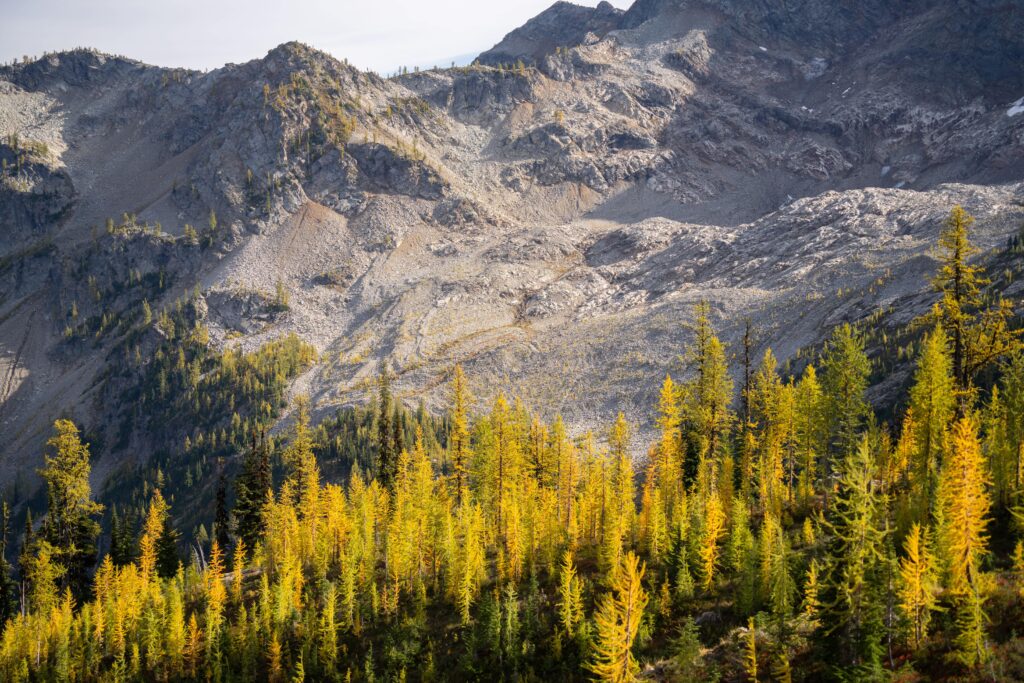
Peak color: late September to mid-October | Entrance fee: none | Trailhead parking: Northwest Forest Pass, $5 daily or $30 annual
This one is different from everything else on the list, and it has the best hiking payoff of the nine. Western and alpine larch are deciduous conifers: every autumn the needles turn greenish gold, then bright yellow, then burnt orange before dropping. Set against granite, alpine lakes and early snow, it produces a display the eastern parks cannot match.
The window is short. Larches are generally at their yellow best for the first two weeks of October and shift orange as the month goes on. The highest passes along the WA-20 corridor, including Maple Pass, Cutthroat Pass and Easy Pass, tend to run from late September to around 12 October and start dropping needles by mid-month. Slightly lower trails like Blue Lake and Cutthroat Lake hold from roughly 1 to 15 October. If you are travelling in for one shot at it, 3 to 12 October covers the most ground.
The honest warning is crowding. Larch season is a genuine event in Washington and the trailhead lots on WA-20 fill absurdly early, in some cases before 5:30am on peak weekends. Midweek is a completely different trail. Go slightly later in the season if you can, when the crowds thin but the lower trees are still holding color. Stay on the trail through the meadows: alpine heather takes decades to recover from a shortcut taken for a photograph.
One access note worth checking before you drive: the North Cascades Highway closes for the winter each year, and while that normally happens well after larch season, the date moves with the first significant snow. Check WSDOT before a late-October trip.
💡 Insider Tip: The national park charges no entrance fee, but most of the larch trailheads sit on Forest Service land rather than inside the park boundary, so you need a Northwest Forest Pass to park: $5 for a day or $30 annual. Buy it before you leave town. There is no reliable cell signal at the WA-20 pullouts, and a ticket while you are on the trail is a poor end to the day.
7. Zion National Park, Utah
Peak color: late October to early November | Entrance fee: $35 per vehicle, valid 7 days | Getting around: canyon shuttle mandatory in season, free with admission
Zion offers a completely different kind of autumn. Instead of a hardwood forest, you get Fremont cottonwoods along the Virgin River turning brilliant gold against Navajo sandstone walls that are red, pink, salmon and white all year regardless of the calendar. Boxelder maple adds reddish orange, bigtooth maple picks up higher in the canyons, and rabbitbrush carries yellow at ground level.
The timing is the latest on this list. Higher elevations start turning at the end of September, the canyon floor cottonwoods usually peak from late October into early November, and the lowest elevations can hold color later still. October is also when Zion is at its best for hiking generally: the temperatures that make Angels Landing brutal in July are gone, and the crowds have thinned from their summer peak.
The Riverside Walk from the Temple of Sinawava is the easiest way to see the cottonwoods, paved and flat enough for strollers, running about a mile to the gateway of the Narrows with cottonwoods on both banks. For a different angle, Taylor Creek in the Kolob Canyons section runs through maple and oak that turn red and orange, and Kolob has no shuttle and a fraction of the crowds.
Practical mechanics: from roughly March through November the shuttle is mandatory in Zion Canyon and private vehicles cannot drive the Scenic Drive, which is where the trailheads for Angels Landing, the Emerald Pools and the Narrows all are. The shuttle itself is free with park admission. Angels Landing needs a separate permit through a Recreation.gov lottery year-round.
8. New River Gorge National Park and Preserve, West Virginia
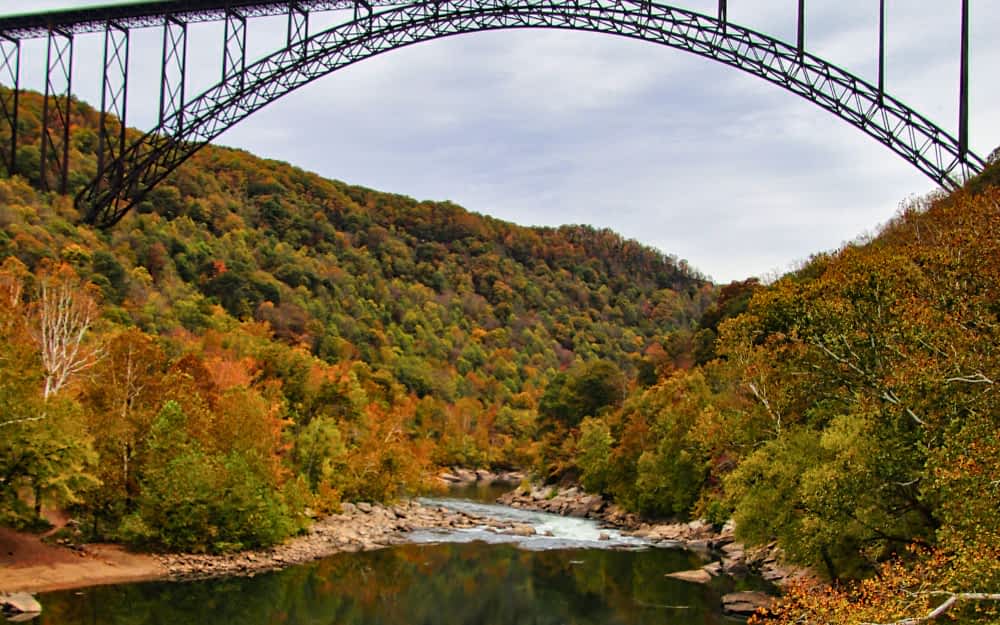
Peak color: mid to late October | Entrance fee: none | Book ahead: nothing required
The most underrated park on this list by a distance. New River Gorge protects more than 70,000 acres along one of the oldest rivers on earth, and the gorge itself creates a vertical color gradient you can see all at once. Standing at Grandview in October you can look down at green foliage along the river and follow it up through every stage of autumn to full color at the rim.
The New River Gorge Bridge is the landmark, a steel arch carrying US-19 nearly 900 feet above the water, and its dark rust color against peak foliage is the shot everyone comes for. The Canyon Rim Visitor Center has an accessible overlook plus a lower one reached by 178 steps down and 178 back up.
For walking, the Endless Wall Trail is the pick. It runs about 2.4 miles point to point along the rim past unbroken sandstone cliffs, with roughly half a mile of road walking to get back to your car, or you can turn around at the Diamond Point overlook for about two miles round trip. From Diamond Point you can see more than a mile up and down the gorge, with the bridge partly visible and the former Kaymoor and Nuttallburg coal sites below. Long Point Trail is the other classic, an easy 3-mile round trip to a rock outcrop with the best straight-on view of the bridge.
One date to know: Bridge Day, held on the third Saturday in October, closes the bridge to traffic while BASE jumpers parachute off it. It is a genuine spectacle and it also brings tens of thousands of people into a small area, so decide deliberately whether you want to be there for it or well clear of it.
💡 Insider Tip: The Fern Creek parking area for the Endless Wall Trail is small and fills fast in October, and cars left on Lansing-Edmond Road get towed rather than ticketed. Park at the Nuttall trailhead instead, about half a mile further along the same road, and walk the trail from the other end. It is the same hike and the lot is consistently emptier.
9. Cuyahoga Valley National Park, Ohio
Peak color: mid to late October | Entrance fee: none | Book ahead: nothing required
Ohio’s only national park is the easiest autumn day on this list, and that is the point of including it. It is free, it sits 20 miles south of downtown Cleveland between Cleveland and Akron, and it packs 33,000 acres of forested gorges, sandstone ledges and river valley into a park you can do properly in a single day with children in tow.
Brandywine Falls is the headline, reached by a boardwalk from a lot that fills early on October weekends. The Ledges Trail is the one that surprises people: a 2.2-mile loop through moss-covered sandstone cliffs and narrow passages, with the Ledges Overlook facing west for sunset. Brandywine Gorge is a 1.4-mile loop, Blue Hen Falls about 3 miles, and the Towpath Trail runs flat along the old canal for as far as you want to walk it.
The park runs a Fall Hiking Spree from 1 September to 30 November across a set of designated trails, which turns a casual visit into something with a bit of structure if you are trying to get kids invested.
Honest assessment: this is not a dramatic park and it will not compete with the Smokies on scale. What it is, is genuinely good October color with no fee, no reservation, no permit and no six-hour drive for roughly three million people a year. Start at Brandywine before the lots fill, then do the Ledges, and keep the Towpath as the section you cut if the weather turns.
The Big Name That Did Not Make the List
Yosemite gets recommended for autumn constantly and it is worth being straight about why it is not here. The color is real: black oaks, dogwoods and cottonwoods on the valley floor turn from October into early November. But it is concentrated in a narrow band of the valley rather than spread across the park, it arrives late, and it is not the reason anyone remembers Yosemite. Go for the granite and treat the leaves as a bonus, rather than planning the trip around foliage and being underwhelmed.
Glacier has the same larch display as North Cascades, but Going-to-the-Sun Road usually closes to through traffic before the needles are at their best, which turns a scenic drive into a long detour. If you want larches, Washington is the more reliable bet.
What You Need to Book and Pay
| Park | Peak window | Entry cost | Reserve in advance? |
|---|---|---|---|
| Great Smoky Mountains | Mid-Sep to early Nov | Free entry, parking tag $5–$40 | No |
| Acadia | Mid to late October | $35 per vehicle, 7 days | Cadillac Summit Road only, $6 |
| Grand Teton | Late Sep to early Oct | $35 per vehicle, 7 days | No |
| Shenandoah | Third week of October | Per vehicle, 7 days | No |
| Rocky Mountain | Mid to late September | Per vehicle | Yes, timed entry, $2 fee |
| North Cascades | Late Sep to mid-Oct | Free, NW Forest Pass $5/day | No |
| Zion | Late Oct to early Nov | $35 per vehicle, 7 days | Shuttle is free, Angels Landing lottery |
| New River Gorge | Mid to late October | Free | No |
| Cuyahoga Valley | Mid to late October | Free | No |
If you are visiting more than two fee parks in a year, the America the Beautiful annual pass at $80 covers entrance for the driver and everyone in the vehicle and pays for itself quickly. From 2026 it requires proof of US residency, such as a passport, state ID, driver’s licence or green card, matched to a photo ID.
One change that caught a lot of people out this year: since 1 January 2026, every non-US resident aged 16 and over pays an additional $100 per person, on top of the standard entrance fee, at eleven of the most-visited parks. Four of the nine on this list are affected: Acadia, Grand Teton, Rocky Mountain and Zion. Non-residents visiting several parks can buy an America the Beautiful Non-Resident Annual Pass for $250, which covers the pass holder plus three additional non-residents aged 16 and over. Great Smoky Mountains, Shenandoah, North Cascades, New River Gorge and Cuyahoga Valley are not part of the programme.
What to Pack
Autumn park trips go wrong on two things: the size of the temperature swing and how early it gets dark. In the mountain West a 30 to 40 degree spread between dawn and midday is normal in late September. By mid-October, an afternoon start on any of these trails can easily finish in the dark.
- A wind shell and a warm mid-layer. Summits and high passes run far colder than the valley forecast, and most of the good light on this list is at dawn.
- A headlamp in every day pack. The single most-skipped item on autumn day hikes.
- Traction for the high trails. Larch routes on WA-20 and the alpine sections in Rocky Mountain can hold ice in shaded gullies by mid-October.
- Bear spray in Grand Teton and Rocky Mountain, and know how to use it before you need it.
- A printed or saved QR code for any reservation. Cell signal at Acadia and in the Smokies is unreliable at exactly the moment you need it.
Autumn Park Kit
A wind shell, a warm hat, a headlamp and micro-traction cover almost everything that goes wrong on an October day hike in these parks. None of it takes up much room and all of it earns its place.
If your boots have been in a cupboard since spring, read how hiking boots should fit before you take on a long descent on wet leaves. And on the steeper rock sections of Alum Cave or the Endless Wall rim, it is worth knowing the difference between hiking and scrambling before you commit to a line.
Check these hiking essentials before your trip (paid links):
- A hiking day backpack
- Comfy pair of men’s boots, or woman’s hiking boots
- Hiking water bottle for hydration
- A cozy men’s and woman’s raincoat / windbreaker for those gusty summits
- A set of hiking poles
Where to Stay
Gateway towns for these parks sell out in foliage season, and the closer you book to your dates the more you pay. Three that put you inside a peak window rather than a two-hour drive from one:
- Gatlinburg or Townsend, Tennessee for the Smokies. Gatlinburg gets you to Sugarlands and Newfound Gap Road; Townsend is the quieter approach for Cades Cove and Little River Road.
- Bar Harbor, Maine for Acadia. Walkable, on the Island Explorer shuttle network, and minutes from the Park Loop Road.
- Fayetteville, West Virginia for New River Gorge. Small, close to the bridge, and dramatically cheaper than the marquee gateway towns.
Find a Base Near Peak Color
Autumn lodging in these gateway towns books out months ahead, and Bridge Day weekend in Fayetteville is effectively full a year in advance. Comparing across booking sites in one search is the fastest way to see what is actually still available for your dates.
Compare stays in Gatlinburg, Bar Harbor and Fayetteville
Planning Your Autumn Park Trip
If your dates are fixed and you are choosing a park around them, work backwards from the timing rather than the park. Mid to late September points you at Rocky Mountain or Grand Teton. The first two weeks of October point at North Cascades or the high Smokies. The third week of October is Shenandoah, New River Gorge and Cuyahoga Valley. Late October into early November is Acadia at the tail end and Zion at its best.
The best time to see fall colors in each US region covers the same logic outside park boundaries, which is useful if you would rather not deal with reservations at all. If you are staying east of the Mississippi, the best national parks on the East Coast covers what else is within reach, and if the Blue Ridge is your target the best hikes in Boone NC covers which Parkway trailheads are open and which sections are still under repair. In Vermont, the 12 best fall hikes for peak foliage gets you an equivalent display with no entrance fee at all.
Frequently Asked Questions
Which national park has the best fall colors?
Great Smoky Mountains, on both quality and duration. It spans roughly 875 feet to over 6,600 feet of elevation and holds more than 100 native tree species, which stretches peak color across six to eight weeks as the display moves down the mountain. That also makes it the most forgiving park to time, because there is almost always some elevation band at peak during October.
When do national parks have peak fall foliage?
It ranges from mid-September to early November. Rocky Mountain and Grand Teton peak earliest, in the second half of September. The North Cascades and the high Smokies follow in the first two weeks of October. Shenandoah, New River Gorge and Cuyahoga Valley peak in the third week of October. Acadia runs mid to late October, and Zion is last, from late October into early November.
Do I need a reservation to visit national parks in the fall?
For most of these, no. Rocky Mountain requires a timed entry reservation through mid-October, and Acadia requires a $6 vehicle reservation to drive the Cadillac Summit Road through 25 October. Zion requires a permit for Angels Landing specifically. The other six on this list need nothing booked in advance, though popular parking areas still fill early.
Which national parks are free to visit in the fall?
Great Smoky Mountains, North Cascades, New River Gorge and Cuyahoga Valley all charge no entrance fee. The Smokies do require a parking tag if you leave a vehicle for more than 15 minutes, at $5 daily, $15 weekly or $40 annual, and most North Cascades trailheads need a Northwest Forest Pass at $5 a day because they sit on Forest Service land.
Is it worth visiting national parks in October?
For most of these, October is the best month of the year. Temperatures are comfortable for hiking, summer crowds drop once schools go back, and the foliage is at its best. The exception is the Smokies, where October is the busiest month of the year rather than the quietest, so weekday visits and early starts matter more there than anywhere else on the list.
How much does the America the Beautiful pass cost in 2026?
The standard annual pass is $80 for US citizens and residents and covers entrance for the driver and everyone in the vehicle at more than 2,000 federal recreation sites. From 2026 it requires proof of residency matched to photo ID. Non-residents pay $250 for a Non-Resident Annual Pass, which also covers the $100 per-person non-resident fee that applies at eleven of the busiest parks.